
Menu
Services


Best Notion Consultant for Startups: Custom Systems for Growing Teams
Every startup is built for speed. In the early stages, teams move quickly, communication is simple, and a handful of tools are often enough to keep everything running. But as your startup grows, those same tools can create operational friction. Information becomes scattered, projects lose visibility, documentation falls behind, and founders spend more time coordinating work than driving the business forward. This is where working with the best Notion consultant for startups becomes a strategic investment rather than a productivity upgrade.
A well-designed Notion workspace is more than a collection of pages or databases. It becomes the operational foundation of your business, connecting projects, documentation, reporting, workflows, and AI-powered automation into one structured system. Instead of reacting to operational challenges, your team gains a centralized workspace designed to support growth from day one.
Why Growing Startups Need More Than Productivity Tools
Most startups don’t struggle because they lack software—they struggle because their systems don’t evolve as the business grows.
In the beginning, spreadsheets, chat apps, and task managers are enough. As new employees join and responsibilities expand, every department begins creating its own way of working. Marketing tracks campaigns in one platform, product teams manage development elsewhere, operations rely on spreadsheets, and leadership spends valuable time collecting updates from multiple sources.
The result isn’t a lack of effort—it’s a lack of operational alignment.
Instead of making faster decisions, founders find themselves chasing information, answering repetitive questions, and managing disconnected workflows. A centralized operational system eliminates these bottlenecks by giving every team a shared source of truth.
Why the Best Notion Consultant for Startups Focuses on Operations
Many businesses believe a Notion consultant simply creates attractive dashboards or installs templates. In reality, templates rarely solve operational problems because no two startups operate the same way.
The best Notion consultant for startups begins by understanding how your business actually works. That includes your workflows, reporting needs, approval processes, documentation, communication patterns, and growth goals.
Instead of delivering a generic workspace, they design a connected operational system where projects, knowledge, dashboards, automation, and collaboration work together. The objective isn’t to build a better Notion workspace—it’s to create a better operating system for your startup.
Signs Your Startup Has Outgrown Its Current Systems
Operational challenges usually appear gradually rather than all at once. If your team is experiencing any of the following, your current systems may no longer support your growth.
- Project updates are spread across multiple tools.
- Team members regularly ask where information is stored.
- Documentation becomes outdated or difficult to find.
- Founders spend hours following up on tasks and approvals.
- Reporting is created manually every week.
- Different departments use disconnected workflows.
- New employees take too long to onboard.
These issues slow execution, reduce visibility, and create unnecessary operational overhead as your startup grows.
What Every Startup Should Build Inside Notion
A scalable Notion workspace should support the way your company operates today while remaining flexible enough for tomorrow.
Core systems often include:
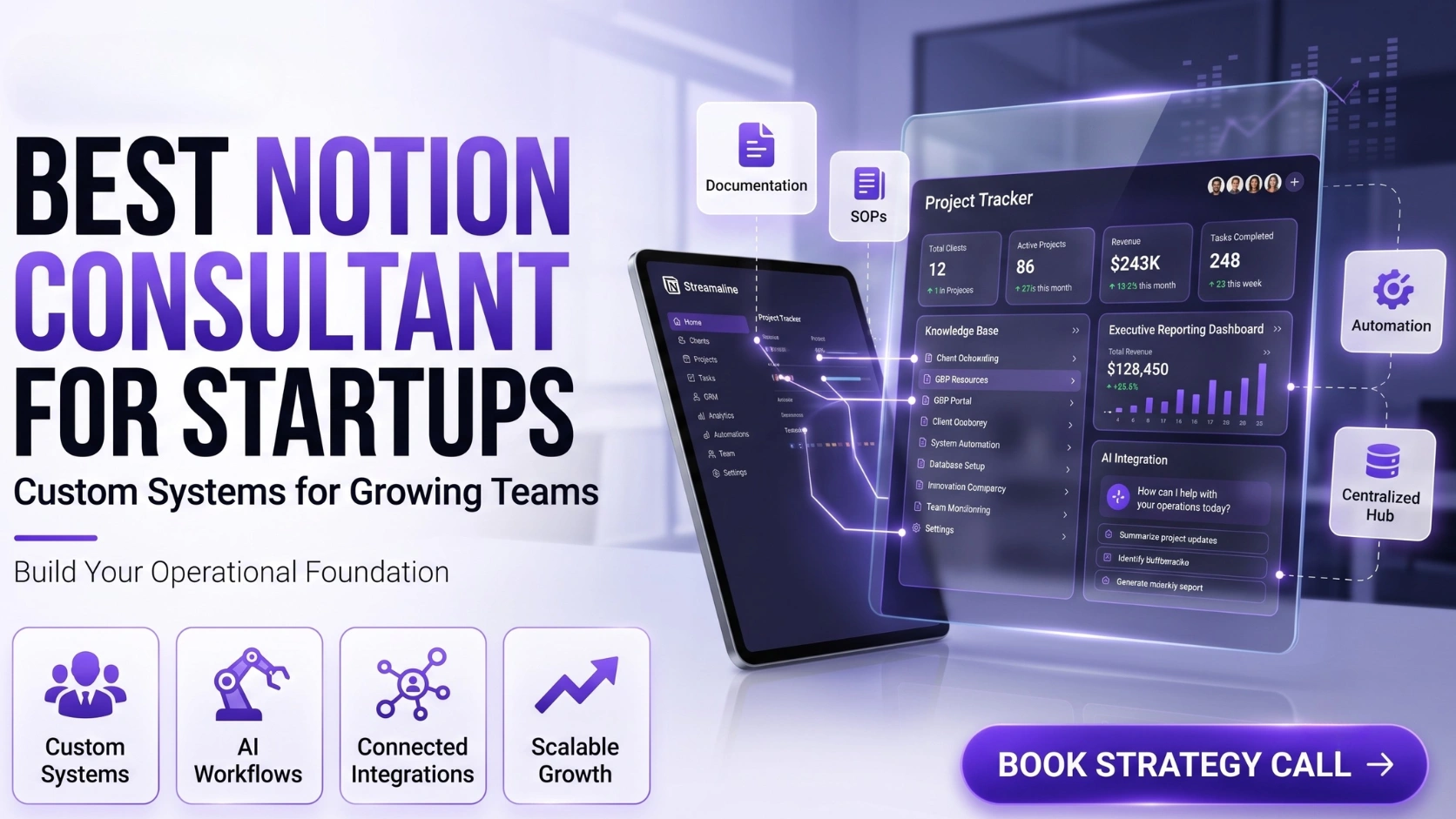
- Startup Operating System – A centralized workspace for projects, documentation, priorities, and operations.
- Project & Task Management – Clear ownership, deadlines, dependencies, and execution tracking.
- Knowledge Base & SOPs – Organized documentation that keeps information accessible as your team grows.
- Executive Dashboards – Real-time visibility into projects, KPIs, priorities, and operational performance.
- AI-Assisted Workflows – Automate repetitive work, improve documentation, and simplify information retrieval.
- Connected Integrations – Bring communication, CRM, reporting, and operational tools into one structured ecosystem.
The goal isn’t to replace every application your business uses. It’s to create one operational hub where teams can work with clarity, consistency, and confidence.
How AI and Notion Help Startups Scale Faster
Many startups use AI for writing content or summarizing meetings, but its biggest impact comes from improving daily operations. When AI is integrated into a well-structured Notion workspace, repetitive administrative work becomes faster, information is easier to access, and teams spend less time searching for updates.
For example, AI can help summarize meeting notes, organize documentation, surface important information instantly, and support recurring workflows. Combined with automation, it reduces manual effort while improving consistency across the business. Instead of adding another tool to your stack, AI becomes part of the operational system your team already uses.
DIY Notion Setup vs Working With a Consultant
Building a Notion workspace yourself is a practical starting point for very early-stage startups. However, as teams expand and operations become more complex, DIY systems often become difficult to maintain.
A startup-focused consultant approaches Notion differently. Rather than organizing pages, they design systems around your business operations. That means connected databases, scalable workflows, reporting dashboards, documentation, and automation that continue supporting the business as it grows.
The difference isn’t better design—it’s better operational thinking. A structured system reduces manual work today while preventing larger operational problems tomorrow.
Why Startups Choose Streamaline
Every startup operates differently, which is why Streamaline doesn’t rely on one-size-fits-all templates. Every engagement begins by understanding your workflows, reporting requirements, operational challenges, and growth objectives before designing a custom system.
Streamaline builds operational foundations that help startups centralize information, improve visibility, automate repetitive work, and create consistent execution across teams. Whether it’s documentation, dashboards, AI-assisted workflows, or connected operational systems, every solution is designed to support long-term scalability—not just immediate productivity.
This approach has helped businesses across multiple industries replace fragmented workflows with structured systems that improve collaboration, reporting, and operational efficiency, allowing teams to focus more on execution and less on coordination.
Frequently Asked Questions
Is Notion suitable for early-stage startups?
Yes. Notion provides a flexible workspace for managing projects, documentation, internal knowledge, and operations. As your startup grows, the workspace can evolve with your business instead of requiring multiple disconnected tools.
When should a startup work with a Notion consultant?
The best time is before operational complexity starts slowing your team down. If projects are becoming difficult to track, documentation is scattered, or manual coordination is increasing, a consultant can help build systems that support future growth.
Can AI improve an existing Notion workspace?
Absolutely. AI can enhance documentation, knowledge management, meeting summaries, workflow execution, and information retrieval. When combined with automation, it helps teams reduce repetitive work while improving operational consistency.
Can Notion replace multiple business tools?
For many startups, yes. A well-designed Notion workspace can centralize project management, documentation, SOPs, reporting, internal knowledge, and team collaboration while integrating with other business applications when needed.
Conclusion
The most successful startups don’t scale because they add more software—they scale because they build better operational systems. As your company grows, disconnected tools, manual processes, and scattered information become barriers to execution.
Working with the best Notion consultant for startups means creating a system that grows alongside your business. Instead of constantly adapting your team to new tools, you build an operational foundation that improves visibility, simplifies collaboration, and supports sustainable growth.
A thoughtfully designed Notion workspace becomes more than a productivity platform. It becomes the central operating system that helps your team execute with confidence, adapt to change, and scale without unnecessary complexity.
Ready to Build a Startup That Scales Without Operational Chaos?
Growth shouldn’t mean adding more manual work or disconnected tools. The right operational system gives your team the clarity, visibility, and structure needed to execute consistently as your startup grows.
Streamaline helps startups build custom Notion systems, AI-powered workflows, and connected operational processes designed around the way modern businesses actually work.
Book Your Strategy Call
Let’s build a system that grows with your startup—not one you’ll outgrow in six months.