
Menu
Best AI Automation Tools for Small Business: Workflows, CRM & Notion
Services


Best AI Automation Tools for Small Business can help growing teams reduce repetitive work, connect everyday workflows, and manage operations without adding unnecessary complexity. The right tools can support lead follow-ups, CRM updates, client onboarding, reporting, task coordination, and internal communication while keeping important business decisions under human control. They need the right systems for the work that repeatedly consumes time: lead follow-ups, CRM updates, client onboarding, reporting, task coordination, and internal communication. The Best AI Automation Tools for Small Business are the ones that connect these processes without making daily operations harder to manage.
The right choice also depends on how your business already works. A simple workflow may only need a no-code automation platform, while a growing company may need CRM automation, AI agents, connected databases, and a structured Notion workspace. The goal is not to automate everything. It is to remove repetitive work while keeping important business decisions under human control.
What Should the Best AI Automation Tools for Small Business Do?
A useful automation stack should connect the tools your team already uses and move information between them reliably.
Look for capabilities such as:
- Multi-step workflow automation
- CRM and lead management
- AI-assisted decision-making
- Data synchronization
- Notifications and task creation
- Reporting and operational dashboards
- Integrations with existing business tools
- Human approval for important actions
Modern automation platforms increasingly support both traditional workflows and AI-driven processes, but controlled automation is still important for small and medium-sized businesses.
Best AI Automation Tools for Small Business Workflows
There isn’t one platform that wins for every company. Different tools solve different operational problems.
Zapier for Simple Cross-Platform Automation
Zapier is useful when a small business needs straightforward connections between commonly used applications. A workflow can connect forms, CRM systems, email, project tools, and other business applications without requiring a development team. Zapier’s current automation offering also includes AI-oriented workflow capabilities.
Make for More Flexible Workflows
Make is a strong option when workflows require multiple steps, conditions, and branching logic. Instead of creating only simple trigger-and-action processes, teams can visually build more detailed automation scenarios.
For businesses with increasingly complex processes, this flexibility can be valuable.
n8n for More Custom Automation
n8n is better suited to businesses that need deeper customization and greater control over their automation infrastructure. It can support complex integrations, APIs, data processing, and AI workflows.
The trade-off is that it generally requires more technical understanding than simpler no-code platforms.
HubSpot for CRM-Centered Automation
If the main automation problem is sales and customer management, a CRM-focused platform can make more sense than a general automation tool.
HubSpot can be useful for managing contacts, leads, sales activities, and customer workflows, particularly when automation needs to stay closely connected to the CRM.
Where Notion Fits Into AI Automation
Notion is different from dedicated automation platforms. Its strength is creating a centralized workspace where projects, documentation, databases, knowledge, and operational information can work together.
For a small business, Notion can become the operational layer around which automation is organized. For example, lead information can connect with tasks, client records, documentation, dashboards, and internal processes.
This is where the Best AI Automation Tools for Small Business should not be viewed as isolated products. A stronger setup connects automation tools with the systems where your team actually manages information.
AI Agents vs. Traditional Workflow Automation
Traditional automation follows predefined rules:
Trigger → Condition → Action
AI agents can handle more flexible processes by interpreting information and deciding what action should happen within defined boundaries.
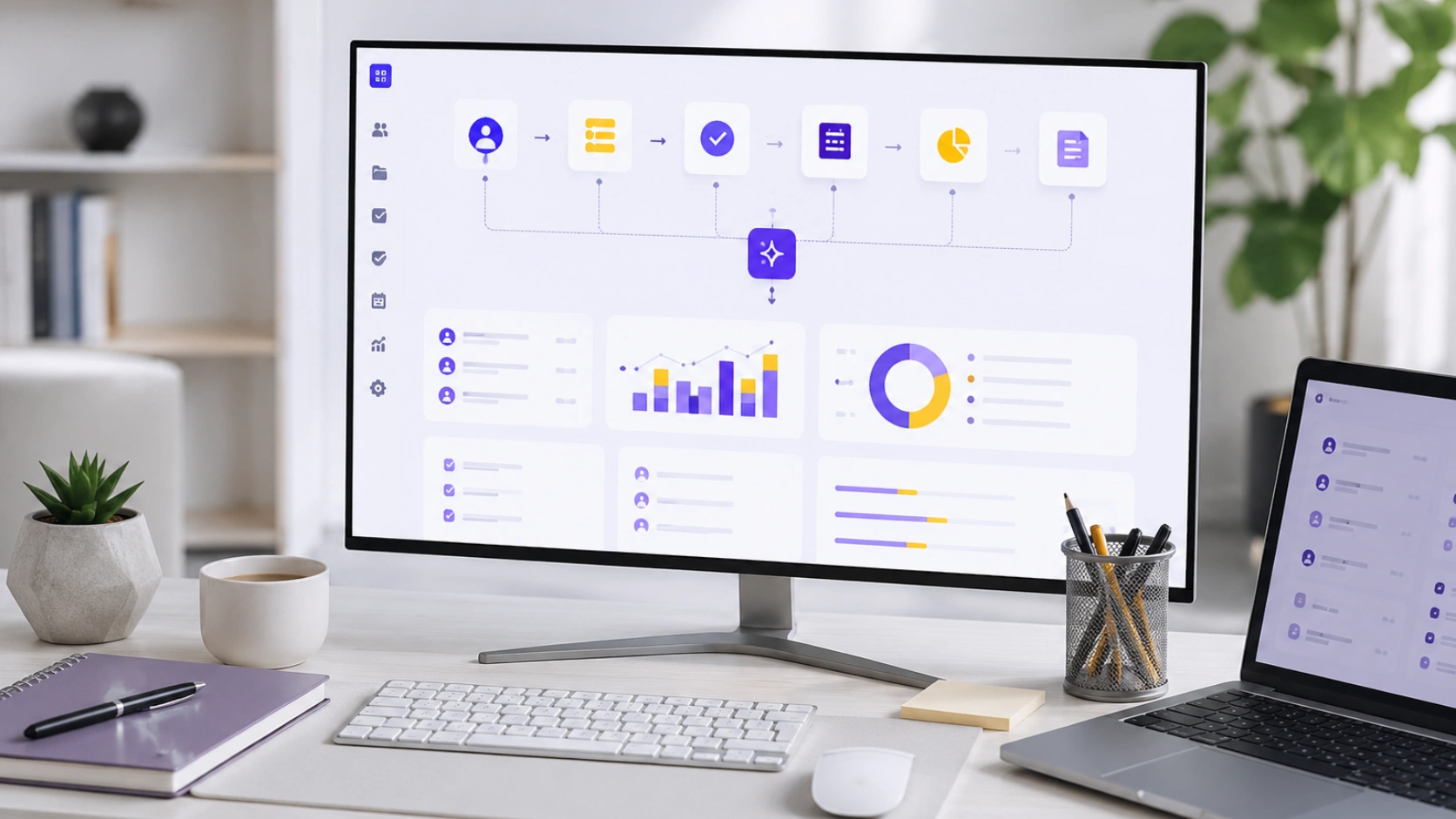
For example, an AI-assisted workflow could review a new inquiry, categorize it, update the CRM, create a follow-up task, and notify the appropriate team member.
That doesn’t mean every process should become autonomous. For most small businesses, the safest approach is to start with repetitive, measurable workflows and keep human approval where judgment is important.
How to Choose the Right Automation Stack
The Best AI Automation Tools for Small Business depend on your actual operational bottleneck.
Choose based on:
Your workflow complexity: Simple processes may need Zapier, while complex workflows may benefit from Make or n8n.
Your CRM requirements: If sales operations are the priority, CRM automation should come first.
Your information structure: If your business relies heavily on documentation, projects, and internal knowledge, Notion can provide a useful operational foundation.
Your AI requirements: Use AI where interpretation, summarization, classification, or decision support adds genuine value.
Your team’s technical capacity: The most powerful platform isn’t useful if your team cannot maintain it.
The Best Tool Is the One That Fits Your Operations
The Best AI Automation Tools for Small Business aren’t necessarily the most advanced tools available. The right stack is the one that reduces repetitive work, keeps information connected, and remains manageable as the business grows.
Streamaline helps businesses connect AI workflows, CRM processes, Notion systems, automation, and operational infrastructure around the way their teams actually work.
Instead of adding another disconnected tool, start by identifying the workflow that wastes the most time—and automate that first.
The Best AI Automation Tools for Small Business become valuable when they solve a real operational problem, not simply because they have more AI features.