The Hidden Cost of Managing Operations Without a Centralized Notion System
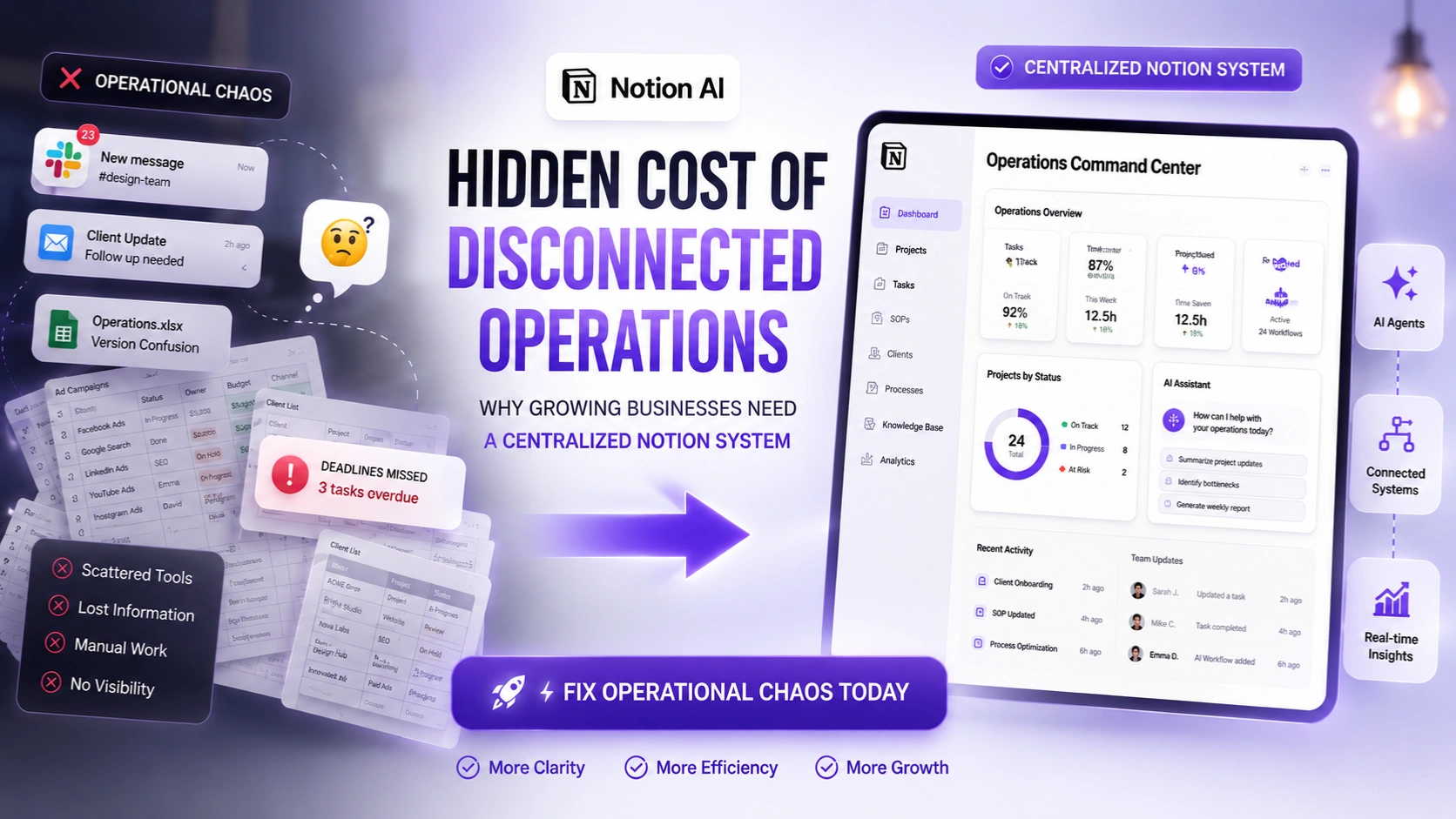
Growing a business is exciting—until operations start slowing everything down.
At first, managing projects through spreadsheets, Slack messages, email threads, shared drives, and a handful of software tools feels manageable. Everyone knows where things are, communication happens naturally, and processes don’t seem complicated.
Then the business grows.
New team members join. More clients come in. Projects become larger. Departments become specialized. Suddenly, information is scattered across multiple platforms, tasks slip through the cracks, and leaders spend more time chasing updates than making decisions.
Most businesses don’t realize this immediately, but disconnected operations create a hidden cost that compounds over time. It impacts productivity, profitability, employee satisfaction, customer experience, and ultimately the company’s ability to scale.
The good news is that these problems are often preventable.
By implementing centralized notion systems, supported by workflow automation, process automation, and AI agents, businesses can regain operational clarity, reduce inefficiencies, and build a stronger foundation for growth.
In this article, we’ll explore the hidden costs of fragmented operations, why they become more expensive as businesses grow, and how a centralized operational system can transform the way your company works.
The Silent Problem Behind Operational Chaos
Most companies don’t wake up one day and decide to create operational complexity.
It happens gradually.
A spreadsheet is created to track projects.
A project management tool is introduced for the marketing team.
Sales starts using its own CRM.
Operations builds separate documentation.
Leadership tracks KPIs in another dashboard.
Individually, these decisions make sense.
Collectively, they create a fragmented system where information lives in multiple places and no one has complete visibility.
The result is operational chaos disguised as productivity.
Many businesses assume they’re organized because they have tools.
The reality is that tools alone don’t create systems.
Without a centralized structure connecting people, processes, and information, teams spend more time managing work than completing it.
What Is a Centralized Notion System?
A centralized Notion system is more than a workspace.
It’s a business operating system.
Instead of storing information across disconnected platforms, a centralized Notion system brings together:
- Company knowledge
- Standard operating procedures (SOPs)
- Project management
- Team documentation
- Operational dashboards
- Client workflows
- Reporting systems
- Internal processes
Everything exists in one connected environment.
This creates a single source of truth that improves visibility, accountability, and collaboration across the organization.
For growing businesses, this shift can have a significant impact on operational performance.
The Hidden Costs of Disconnected Operations
Many operational problems are easy to ignore because they don’t appear on a profit-and-loss statement.However, they create substantial costs over time.
1. Lost Productivity
One of the biggest hidden expenses is the amount of time employees spend searching for information.
Consider how often team members ask questions like:
- Where is the latest process document?
- Which spreadsheet contains the current data?
- Has this task already been completed?
- Who owns this project?
If employees spend even 30 minutes each day searching for information, the cost adds up quickly across an entire team.
The larger the organization becomes, the more expensive this problem gets.
2. Duplicate Work
When information is scattered, teams often recreate work that already exists.
A process gets documented twice.
Two departments create similar reports.
Different versions of the same file circulate internally.
Without centralized knowledge management, duplication becomes inevitable.
Not only does this waste time, but it also creates confusion about which information is correct.
3. Slow Decision-Making
Leaders make better decisions when they have access to accurate, real-time information.
When data is spread across multiple tools, reporting becomes slow and often unreliable.
Instead of spending time solving problems, managers spend time gathering information.
This delay affects everything from project execution to strategic planning.
4. Operational Bottlenecks
Many growing businesses unknowingly create dependencies on key individuals.
Critical information lives inside someone’s inbox.
Processes exist only in an employee’s memory.
Approvals depend on one person.
When these individuals are unavailable, work stops.
A business cannot scale effectively when operations rely on specific people rather than documented systems.
5. Reduced Team Alignment
When departments use different tools and workflows, alignment becomes difficult.
Marketing may be working toward one goal.
Operations may be focused on another.
Sales may have completely different priorities.
Without a centralized system connecting everyone, teams struggle to stay aligned.
Why Businesses Outgrow Spreadsheets
Spreadsheets are incredibly useful.
But they were never designed to function as a complete operational infrastructure.
As businesses grow, spreadsheets begin showing their limitations.
Common issues include:
- Version control problems
- Limited collaboration
- Lack of automation
- Poor visibility
- Manual reporting requirements
- Information silos
A spreadsheet can track data.
It cannot effectively manage an entire company’s operations.
This is one reason many businesses eventually move toward custom Notion systems that combine databases, documentation, workflows, and dashboards into a unified environment.
The Role of Workflow Automation in Modern Operations
Centralization solves one problem.
Automation solves another.
Even with a well-organized system, manual work can still slow teams down.
This is where workflow automation becomes valuable.
Workflow automation eliminates repetitive tasks by automatically moving information between systems and triggering actions when specific conditions are met.
Examples include:
- Creating projects automatically after a sale closes
- Assigning onboarding tasks to team members
- Sending approval requests
- Updating project statuses
- Generating reports
- Notifying stakeholders about important changes
Instead of employees performing administrative tasks repeatedly, the system handles them automatically.
This allows teams to focus on high-value work rather than routine processes.
How AI Agents Are Changing Business Operations
Artificial intelligence is becoming an increasingly important part of operational management.
Unlike traditional automation, which follows predefined rules, AI agents can assist with information retrieval, analysis, and decision support.
Imagine a new employee asking:
“How do we handle client onboarding?”
Instead of searching through multiple folders and documents, an AI agent can instantly provide the correct process.
Or consider a manager who wants an update on project performance.
An AI agent can summarize project status, identify bottlenecks, and highlight risks without requiring manual reporting.
As organizations continue adopting AI, businesses with centralized operational systems will have a significant advantage because their information is already organized and accessible.
Real-World Example: A Growing Agency's Operational Transformation
Consider a digital marketing agency with twenty-five employees.
The company managed operations using:
- Google Sheets
- Slack
- Shared folders
- Separate project management tools
As the agency grew, operational challenges became more frequent.
Common issues included:
- Missed deadlines
- Inconsistent onboarding
- Communication breakdowns
- Duplicate work
- Delayed reporting
Leadership recognized that growth was creating operational complexity faster than the team could manage.
The solution was implementing a centralized Notion system supported by workflow automation.
The agency created:
- A centralized knowledge base
- SOP documentation
- Automated onboarding workflows
- Department dashboards
- Project tracking systems
- KPI reporting
Within months, the company experienced:
- Faster project delivery
- Improved accountability
- Reduced administrative workload
- Better visibility across departments
- Stronger operational consistency
The most important outcome wasn’t simply efficiency.
It was scalability.
The business could grow without constantly increasing operational complexity.
Signs Your Business Needs a Centralized Notion System
Not every company requires a sophisticated operational infrastructure immediately. However, certain warning signs indicate it’s time to rethink your systems.
Your Team Repeatedly Asks the Same Questions
If employees frequently search for information or request process clarification, your knowledge management system may be insufficient.
Information Exists in Multiple Places
When documentation, tasks, and reports are spread across different platforms, visibility suffers.
Reporting Takes Too Long
If generating operational reports requires manual effort every week, automation opportunities likely exist.
Processes Depend on Specific Individuals
Businesses become vulnerable when critical knowledge isn’t documented.
Growth Feels Increasingly Chaotic
Growth should create opportunity, not confusion. If operations become harder with every new employee or client, your systems may need restructuring.
Common Mistakes Businesses Make
Even companies that recognize operational problems often make implementation mistakes.
Mistake #1: Adding More Tool
Many organizations respond to inefficiency by purchasing additional software.More tools often create more complexity.The goal should be creating a connected operational ecosystem rather than expanding the software stack.
Mistake #2: Automating Poor Processes
Automation doesn’t fix broken workflows.If a process is inefficient, automating it simply makes inefficiency happen faster.Always optimize before automating.
Mistake #3: Ignoring Documentation
Strong documentation is the foundation of operational excellence.Without clear processes, consistency becomes difficult.
Mistake #4: Waiting Too Long
Many businesses postpone operational improvements until problems become severe.By that point, inefficiencies are already affecting performance.Proactive investment usually produces better results than reactive fixes.
Why a Notion Consultant Can Accelerate Results
While Notion is flexible, building an effective operational system requires strategic planning.A skilled notion consultant helps businesses:
- Design scalable workflows
- Structure databases
- Organize knowledge management systems
- Implement workflow automation
- Create operational dashboards
- Improve process efficiency
Rather than simply setting up software, the goal is designing an operational framework that supports long-term growth.This is particularly valuable for agencies, startups, service businesses, and rapidly growing organizations.
Quick Wins to Improve Operations Today
You don’t need a complete transformation overnight.Start with these practical improvements:
Centralize Documentation
Create one location for processes, SOPs, and company knowledge.
Audit Repetitive Tasks
Identify administrative work that could be automated.
Standardize Key Processes
Document recurring workflows to improve consistency.
Improve Visibility
Build dashboards that provide real-time operational insights.
Eliminate Redundant Tools
Simplify your software stack wherever possible.Small operational improvements often create significant long-term benefits.
The Future of Business Operations
Business operations are evolving rapidly.
Companies that rely on disconnected systems will increasingly struggle to compete with organizations that embrace centralized operational infrastructure.
The future belongs to businesses that combine:
- Centralized knowledge management
- Workflow automation
- Process automation
- AI-powered operations
- Real-time visibility
These capabilities allow organizations to move faster, make better decisions, and scale more effectively.
Most importantly, they free teams from administrative complexity and allow them to focus on growth.
Conclusion
Operational inefficiency rarely appears as a single dramatic problem.
Instead, it shows up as missed opportunities, wasted time, communication gaps, duplicate work, and slower execution.
These costs accumulate quietly until they begin limiting growth.
A centralized Notion system provides a practical solution by bringing documentation, projects, workflows, reporting, and team collaboration into a single connected environment.
When combined with workflow automation, process automation, and AI agents, businesses gain more than efficiency.
They gain clarity.
And clarity is one of the most valuable assets a growing company can have.
Ready to Build a Smarter Operational Foundation?
If your team is struggling with disconnected tools, manual processes, and limited operational visibility, now may be the right time to explore a more centralized approach.
At Streamaline, we help growing businesses design custom Notion systems, workflow automation solutions, and scalable operational frameworks tailored to their unique needs. Whether you’re an agency, startup, or established company preparing for growth, the right operational system can help you reduce complexity, improve efficiency, and scale with confidence.